
More than 50,000 people have now completed the Values Exercise. Family, health, and happiness come out on top year after year, in more or less every group we look at.
Nobody is surprised by that, including us.
The interesting part shows up afterward, in what people write to us once they’ve finished. Almost all of it is some version of what now? And when we follow up, what they mean is usually more specific than that. They know what matters to them. They’re stuck on what to do when two of those things want different things.
The list is the easy part
Give someone a deck of cards and thirty seconds and they’ll produce a list that’s honest and mostly right. We’ve watched thousands of people do it. The list almost never contains anything they didn’t already know about themselves.
If naming your values were the hard part, everyone who finished the exercise would walk away living in alignment and we’d be out of a job. What actually happens is that people finish with a clear list and a feeling that something is still unresolved.
Our best explanation is that a list of values, sitting there on its own, is a description of what you’d like to be true about yourself. It only starts doing any real work once the values begin competing with each other, which they always do eventually.
Where values collide
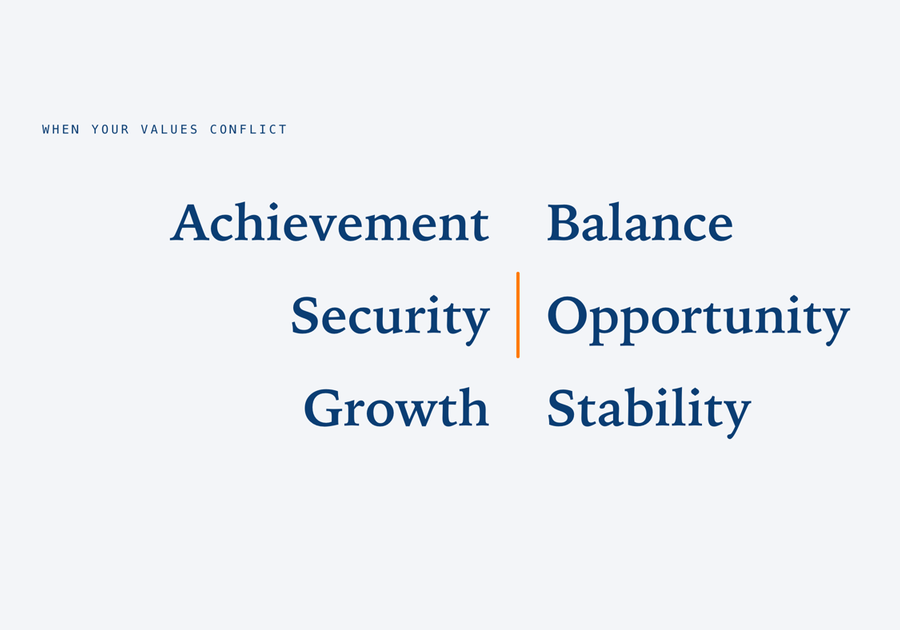
Achievement and balance. Security and opportunity. Growth and stability.
You can hold both sides of any of those pairs sincerely, and most people do. The trouble is that they don’t stay abstract. They get resolved in ordinary moments, whether or not you’re paying attention: the job offer that pays more and costs more, the conversation you keep putting off because it’s easier not to have it, the calendar that says something different about you than you’d say about yourself.
That’s usually what’s going on when a decision feels difficult. It’s rarely a shortage of information. Two things you care about have collided, and choosing one means spending the other. It almost never announces itself that way, though. It shows up looking like logistics.
Why the tension doesn’t go away
We run into an assumption a lot: that if you were just clear enough about your values, the tension would resolve itself. It doesn’t, and we’d go further and say it isn’t supposed to.
Competing values usually mean your life has more than one thing in it worth protecting. Someone who feels no pull at all between achievement and balance has generally either given up on one of them or stopped noticing.
So the goal isn’t really to resolve the tension. It’s to see it while it’s happening, to know which two things are pulling and what you’re trading for what. That’s roughly the difference between making a decision and having one happen to you.
It’s also why values tend to sharpen during a hard season. When things are stable you can hold everything loosely. Pressure makes you choose, and the choice tells you something.
The Freeze Exercise
Noticing is a skill, and it can be practiced. One tool we use with leaders is the Freeze Exercise, a short pause built around three questions:
- What are you thinking right now?
- What are you feeling right now?
- What are you doing right now?
It’s meant to break autopilot. It’s most useful at the exact moment two values are competing, because that moment usually doesn’t feel like a values conflict at all. It feels like irritation, or urgency, or just wanting to get the thing over with. The pause is what gives you room to respond instead of react.
A two-minute version you can do right now
The Freeze Exercise works in real time. This one works backward.
Take your top five values. Find the two that most often pull in opposite directions. Not your two favorites, the two that argue with each other. Then look at your last three significant decisions and ask which one you chose.
That’s it. That’s the whole thing.
Most people find this uncomfortable and clarifying at the same time, because it separates what you actually value from what you’d like to value. Your calendar, your budget, and your last three hard calls say more about your values than any list you’d write about yourself.
If the pattern lines up with your list, that’s genuinely worth knowing. If it doesn’t, be careful what you conclude from it. You probably haven’t found a character flaw. You’ve found the one place where a small change would do the most work.
Where this actually starts
Naming what matters to you is where this starts. The more interesting work is watching how those values behave under load, in decisions and conversations and priorities and relationships.
Most of the people we talk to don’t need more information about their values. They need a clearer look at the trade they’re already making.
If you haven’t taken the Values Exercise, it takes about ten minutes and there’s nothing to sign up for.